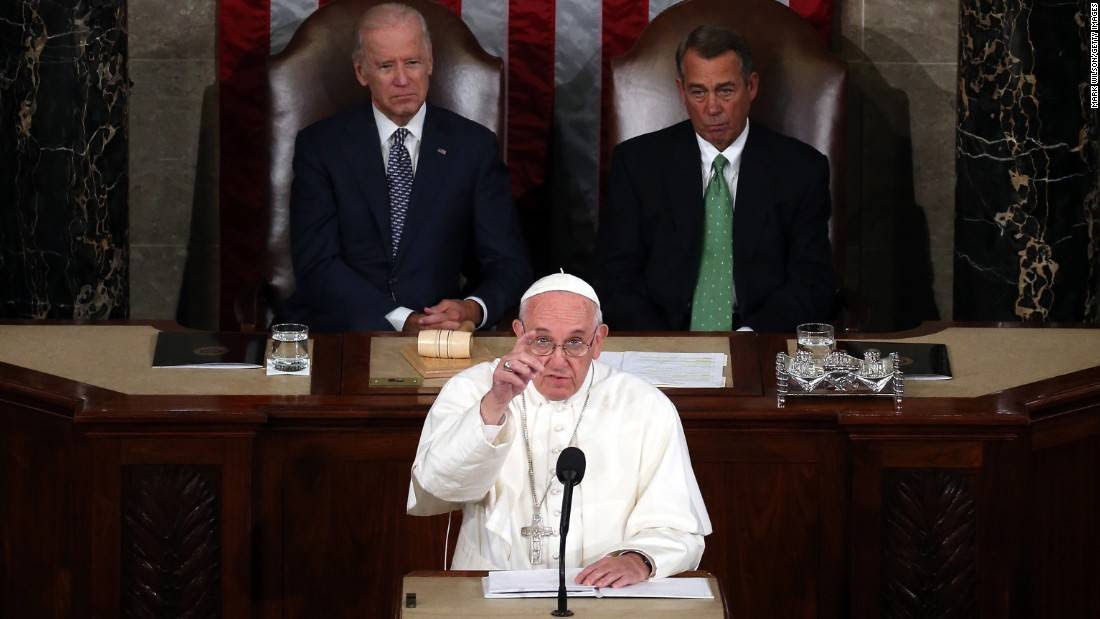
Pope Francis addresses a joint meeting of the U.S. Congress on September 24.
Pope Francis
called on the Catholic church
on Tuesday to stop clinging to
conservatism and fundamentalism as a defensive response to the problems
it is facing, and said the church ought to be “bruised, hurting and
dirty” instead of obsessed with money and power.
The
sweeping remarks
before an audience of Italian bishops at a conference in Florence were a
stark reminder of the way in which Pope Francis is trying to shake up a
church that in many ways is losing relevance around the world, and
continues to be
battered by allegations of financial mismanagement and greed at the heart of the Vatican.
“Before the problems of the church it is not useful to search for
solutions in conservatism or fundamentalism, in the restoration of
obsolete conduct and forms that no longer have the capacity of being
significant culturally,” the pope said.
“Christian doctrine is not a closed system incapable of generating
questions, doubts, interrogatives. But it is alive, knows being
unsettled … it does not have a rigid face, it has a body that moves and
grows, it has a soft flesh: it is called Jesus Christ.”
The comments come at a critical juncture for Francis. Last month, a
high-level group of bishops from around the world met at the Vatican and
engaged in a vigorous debate over how the church ought to respond to changes in the modern family, including the prevalence of divorce.
While Francis has cast himself as a reformer who is seeking to
portray the church as a less rigid and less dogmatic institution, which
stands with people who live on the margins of society, there are
factions in the church that are vigorously resisting his plea for the
church to be more flexible and open.
On Tuesday, he asked for the Italian church to be protected “from
every pretence of power, image and money” and said Christians ought not
to be obsessed with power even when it was power that was “useful to the
social image of the church”.
“I would like an Italian church that is unsettled, always closer to
the abandoned, the forgotten, the imperfect,” said Francis. “I desire a
happy church with face of a mother who understands, accompanies,
caresses.”
Austen Ivereigh, the papal biographer who wrote
The Great Reformer,
said Francis was clearly aiming some of his message directly at the
Italian church, which receives a subsidy from the state and could be
seen by Francis as being too conformist and pro-establishment.
“The Italian church is very large and wealthy in terms of property.
This was a call for the Italian church to be more missionary, less
dependent on status and wealth, and more radical and pro-poor,” Ivereigh
said.
Before his speech to bishops, Francis visited the city of Prato,
where seven Chinese nationals were killed in 2013 following an
industrial fire in a factory where they lived and worked. Francis
criticised the
“inhuman” conditions they lived in.
“The life of every community requires that we fight the cancer of
corruption, the cancer of human and labor exploitation and the poison of
illegality,” he said.


